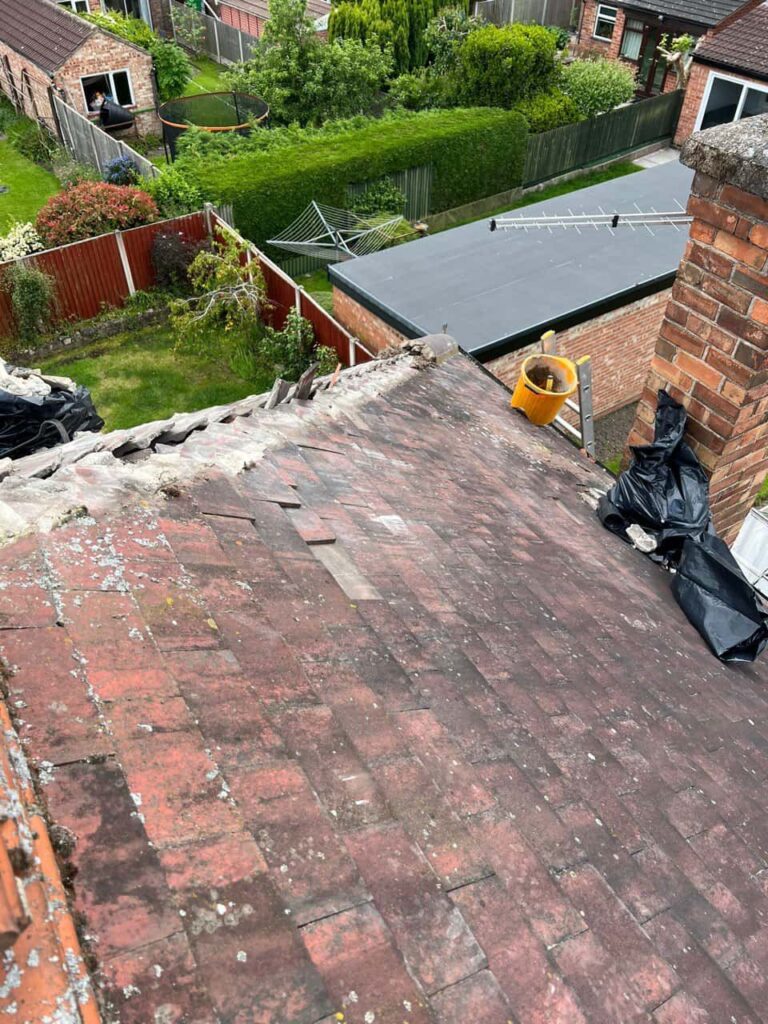
Strong winds and storms can place additional pressure on a roof, particularly where roofing materials are already weathered, loose or beginning to deteriorate. Damage is not always immediately obvious from ground level, and a roof can sometimes appear largely intact even when individual tiles, slates or roof details have moved.
For homeowners in Hazlemere, Buckinghamshire, checking for signs of storm-related roof damage can help identify problems before they develop into water ingress or wider deterioration. The most important point is that not every storm automatically causes serious roof damage, but demanding weather can expose weaknesses that were already developing.
A professional inspection can help distinguish between a genuinely localised defect and a broader roofing issue. This allows repairs to remain proportionate while making sure that vulnerable areas are not overlooked.
What Signs of Roof Damage Should You Look for After Strong Winds?
After particularly strong winds or a storm, useful warning signs can include:
- Missing roof tiles or slates
- Slipped or displaced roofing materials
- Cracked or broken tiles
- Loose ridge or hip components
- Damaged flashing
- Debris on the ground around the property
- New damp patches on ceilings or walls
- Water entering during or after rainfall
- Changes in the appearance of the roofline
- Movement around vulnerable roof details
- Damage affecting previously repaired areas
- Repeated problems following periods of strong weather
These signs should be viewed together with the overall condition of the roof rather than treated as automatic evidence that major roofing work is needed.
Missing Tiles Are One of the Most Obvious Signs
If a tile or slate is missing after strong winds, the affected section of roof has lost part of its primary weather-shedding layer.
This does not automatically mean the complete roof has failed.
Where one or two units have been displaced and the surrounding covering remains sound, a local repair may be sufficient.
However, the area should still be assessed promptly because the materials beneath are not intended to remain exposed indefinitely.
Slipped Tiles Can Be Less Noticeable
A tile does not have to fall completely from the roof to create a problem.
Strong winds can sometimes move a tile or slate just enough to expose part of the roof beneath it.
From ground level, the displacement may appear minor.
Even so, an opening can allow rain to reach areas that are normally protected.
This is why apparently small movement can still justify closer inspection.
Cracked Tiles Can Be Caused or Exposed by Storm Conditions
Roof tiles may already contain small areas of weakness before a storm arrives.
Wind pressure, movement and impact from debris can make existing damage more noticeable.
A cracked tile does not necessarily require extensive roof work, but it should be assessed according to the severity of the damage.
If several tiles in the same area show similar deterioration, the surrounding covering may also need attention.
Slate Roofs Can Develop Localised Movement
Slate roofs can be affected by strong weather in much the same way as tiled roofs.
Individual slates may slip, crack or become displaced.
Where only one or two areas are affected, localised repair may be appropriate.
If movement appears across several parts of the roof, the cause should be considered more broadly.
Repeated slippage can indicate that the issue is not limited to one isolated slate.
Debris on the Ground Can Provide a Useful Clue
After strong winds, pieces of tile, slate or roofing material found around the property can indicate that something has become damaged above.
The location of the debris does not always reveal exactly where it came from because wind can move lightweight material.
Even so, it is a useful reason to have the roof checked.
Visible debris should not be ignored simply because the roof still appears complete from ground level.
No Debris Does Not Mean the Roof Is Undamaged
The opposite is also true.
A roof can develop movement without any material falling to the ground.
Tiles may shift slightly, flashing can lift, or ridge details may loosen while remaining in place.
This is why the absence of broken material around the property does not prove that the roof has escaped damage.
Other warning signs should still be considered.
Ridge Tiles Can Be Vulnerable to Strong Winds
Ridge tiles sit at a prominent point on the roof and are exposed to demanding weather.
Strong winds can reveal weakness in the materials or bedding around these areas.
Movement may not always be easy to identify from below.
Where a ridge appears uneven, displaced or damaged, professional assessment can determine whether local repair is required.
The surrounding ridge line should also be considered rather than focusing on one section alone.
Hip Areas Should Also Be Checked
Hip sections are another exposed part of many roofs.
Wind can place pressure on these areas, particularly if any part of the existing installation has already deteriorated.
Visible movement or missing components should be investigated.
As with ridge damage, a local issue may remain suitable for repair if the rest of the roof is in reasonable condition.
The extent of deterioration should guide the response.
Flashing Can Become Damaged or Displaced
Flashing helps protect vulnerable roof junctions.
Strong weather can sometimes expose existing weakness or move sections that are no longer secure.
Damage may occur around roof junctions or other details where flashing is present.
If flashing is no longer performing effectively, water can enter even when the main roof covering remains largely intact.
This is why storm inspections should include more than tiles and slates.
Chimney Areas Can Need Careful Attention
Areas around chimneys often contain several different roofing details.
Strong winds can affect surrounding tiles, slates and flashing.
If damp appears internally near a chimney after a storm, it is important not to assume immediately that one particular component is responsible.
Water can travel before it becomes visible indoors.
A professional assessment can consider the surrounding roof area as a whole.
Water Stains Can Appear After the Storm Has Passed
Not every leak becomes visible during the storm itself.
Water may enter the roof and travel internally before appearing as a ceiling stain later.
This delay can make it difficult to connect the internal mark with the original weather event.
If a new damp patch appears after strong winds or heavy rain, the roof should be considered as a possible source.
The actual entry point may be some distance from the visible stain.
Water Can Travel Through the Roof Structure
One of the most important things to understand about roof leaks is that water does not always fall directly beneath the external defect.
It can move along roofing components before appearing elsewhere.
This means a stain on one section of ceiling may originate from a defect higher up the roof.
Professional leak investigation takes this movement into account.
Simply repairing the roof directly above the internal mark may not resolve the actual problem.
Strong Winds Can Reveal Pre-Existing Weaknesses
Storm damage is not always completely new damage.
A roof may already contain loose fixings, weathered tiles or deteriorating roof details.
Strong winds can expose these weaknesses by causing movement where the roof was already becoming vulnerable.
This distinction matters because the storm may be the event that makes the problem visible rather than the sole cause of deterioration.
The wider condition should therefore be considered.
Repeated Storm-Related Damage Can Indicate a Pattern
One isolated slipped tile after unusually demanding weather may remain a straightforward repair.
If similar problems occur repeatedly following periods of strong wind, the roof may need closer assessment.
Repeated movement can suggest that certain materials or areas are no longer as secure as they should be.
Treating every occurrence as a completely separate incident may overlook a developing pattern.
Previously Repaired Areas Should Be Considered
Past repairs do not automatically create weak points.
A sound previous repair may continue performing well.
However, if storm damage appears close to an older repair, the surrounding materials can be checked to determine whether movement has occurred nearby.
The relationship between old and new defects can provide useful information about the overall roof condition.
Storm Damage Can Affect More Than the Roof Covering
The visible tiles or slates are only one part of the roof.
Strong weather can also affect ridge details, flashing and other exposed components.
This is why checking only for missing tiles may not provide the full picture.
A professional roof inspection considers the different parts that work together to keep the property weather-resistant.
Small Openings Can Still Allow Water In
A roof does not need to contain a large hole for moisture to enter.
A slightly displaced tile or damaged junction can create enough of an opening for wind-driven rain to pass beneath the covering.
The problem may only become obvious during particular weather conditions.
This can explain why some roofs leak during storms but appear unaffected during lighter rainfall.
Wind-Driven Rain Can Find Vulnerable Points
During strong weather, rain can be driven at different angles.
This places additional pressure on areas that normally remain protected during ordinary rainfall.
A small defect that has not previously caused a visible leak may therefore become noticeable during a storm.
The fact that leaking stops afterwards does not necessarily mean the defect has disappeared.
The opening may still remain and could allow further ingress during future demanding weather.
New Internal Damp Should Not Be Ignored
Fresh water marks on ceilings or upper walls after a storm provide useful evidence that moisture may have entered.
Even if the mark is small, it should be monitored and investigated.
Repeated wetting can expand the affected area.
The objective of roof repair is to stop further water entering through the defect before the problem becomes more widespread.
Ceiling Marks May Not Reflect the Size of the Roof Defect
A relatively small external opening can create a surprisingly noticeable internal stain.
Equally, a larger defect may not immediately result in severe visible damage.
This is why the appearance of the ceiling should not be used to estimate the seriousness of the external roofing problem.
The roof itself needs to be assessed.
Roof Movement May Be Subtle From Ground Level
Some storm-related changes are easy to see.
Others are not.
Slightly lifted tiles, loose flashing or minor ridge movement can be difficult to identify safely from the ground.
This is one reason professional inspection can be useful after severe weather when there are signs that something may have changed.
Avoid Climbing Onto the Roof Yourself
Homeowners should not attempt to investigate suspected storm damage by walking on the roof.
Apart from the difficulty of working safely at height, walking on tiles or slates can create additional damage.
Some defects are also difficult to diagnose without understanding how roofing materials overlap and interact.
A professional assessment is the more appropriate way to investigate suspected problems.
Use Ground-Level Observations Instead
There are still useful checks that can be made safely from ground level.
Look for changes in the roofline, missing materials, obvious displacement or debris.
Internally, check upper ceilings and roof spaces where safely accessible for signs of water entry.
These observations can help identify whether professional inspection is needed.
They should not involve accessing the roof surface itself.
Strong Winds Do Not Automatically Mean You Need a New Roof
Experiencing a storm does not mean the complete roof requires replacement.
Many storm-related defects remain localised.
One missing tile, a damaged piece of flashing or a small section of ridge damage may be repairable where the surrounding roof remains sound.
The appropriate response should be determined by the extent and pattern of damage rather than by the weather event alone.
Localised Repairs Can Often Restore the Affected Area
Where the damage is genuinely confined to a small section, professional roof repair can focus on that area.
The surrounding materials should still be assessed to confirm that they remain secure.
Once the cause and extent are understood, the repair can remain proportionate.
This avoids unnecessary work elsewhere on the roof.
Several Damaged Areas May Need Broader Assessment
The situation changes when storm damage appears across several unrelated sections.
Tiles may be displaced on more than one slope, ridge details may be affected and internal leaks can develop in different areas.
This wider distribution may indicate that the roof was already experiencing broader deterioration.
Professional inspection can determine whether individual repairs are still appropriate.
One Leak Does Not Prove Widespread Roof Failure
A leak after a storm can understandably cause concern.
However, one leak can still originate from one local defect.
The main priority is to identify the point where water is entering.
If the surrounding covering remains in serviceable condition, targeted repair may be sufficient.
Replacement should not be assumed from one isolated incident.
Multiple Unrelated Leaks Are More Significant
If water begins entering through several different parts of the property after demanding weather, the roof deserves more comprehensive assessment.
This can indicate that several areas have become vulnerable at the same time.
The pattern of defects is often more useful than the severity of one individual leak.
A broader review can establish whether deterioration is widespread.
The Condition Before the Storm Matters
A roof that was already showing signs of wear may respond differently to strong weather from one that was in good condition.
Existing loose tiles, ageing details or previous movement can make certain areas more vulnerable.
Storm assessment should therefore consider both the new damage and the existing condition.
This helps distinguish genuinely isolated impact from wider deterioration.
Cracks and Movement Should Be Assessed Together
A cracked tile may be an isolated defect.
Several cracked or displaced tiles in one area can suggest that the roof has experienced a greater degree of disturbance.
The surrounding covering should be inspected for related movement.
Repairing only the most visible damaged unit may be insufficient if adjacent materials have also shifted.
Flat Roofs Can Also Be Affected by Storm Conditions
Strong winds and heavy rain can expose weaknesses in flat roofing.
Damage may involve surface deterioration, edges or roof details rather than individual tiles.
If water ingress appears after a storm, the complete affected area should be assessed.
Simply treating the internal damp mark does not identify the external route of entry.
Flat Roof Water Ingress Needs Accurate Diagnosis
Water movement across a flat roof can make leak tracing difficult.
The visible damp point inside may not sit directly beneath the external defect.
Inspection should therefore consider the surface, edges, junctions and surrounding details.
A focused repair can then be carried out where the defect is genuinely localised.
Storm Debris Can Cause Impact Damage
Branches and other debris can occasionally strike the roof during strong weather.
Even where the debris does not remain on the roof, impact may crack or displace individual materials.
If there has been obvious debris around the property after a storm, it can be worthwhile checking for signs of corresponding roof damage.
The extent of any impact should be professionally assessed where necessary.
Gutters Can Provide Clues About Roof Condition
Although the primary concern is usually the roof itself, gutters can sometimes contain pieces of damaged roofing material after severe weather.
Fragments may indicate that tiles, slates or other components have deteriorated.
This does not identify the precise location of the defect, but it can provide another reason for a closer roof inspection.
Unusual Roofline Changes Deserve Attention
The roof should generally maintain a consistent appearance.
If one section suddenly appears uneven or noticeably different after strong winds, further assessment may be appropriate.
Changes can sometimes indicate displaced materials.
Ground-level visual checks cannot diagnose every problem, but they can reveal that something has changed and warrants professional attention.
Prompt Repairs Can Help Prevent Water Damage From Spreading
Where storm damage creates an opening, repairing it promptly limits the opportunity for further rainfall to enter through the same weakness.
A local defect can remain manageable if addressed early.
If it is left exposed through repeated periods of rain, moisture may travel further beneath the covering.
The purpose of timely repair is therefore not only to correct visible damage but also to prevent the problem becoming more extensive.
Temporary Dry Weather Does Not Mean the Problem Has Resolved
A roof may stop leaking as soon as the rain ends.
This does not mean that the displaced tile, cracked material or damaged flashing has repaired itself.
The roof may remain vulnerable until the defect is addressed.
Waiting for the next storm to confirm the problem can allow additional water ingress.
Roof Damage Should Be Assessed Before It Worsens
Some defects remain small for a period, while others can develop as wind and rain continue acting on the affected area.
A loosened component may move further during another period of strong weather.
Professional assessment can identify what needs attention before additional movement occurs.
This is especially useful where the initial damage is difficult to see from ground level.
Professional Inspection Helps Separate Cosmetic Changes From Functional Damage
Not every visible change after a storm affects the roof’s ability to shed water.
Some surface marks may be cosmetic.
Other defects, although relatively small, can compromise the roof covering.
Professional assessment helps distinguish between these situations.
This prevents unnecessary work while making sure that genuine weaknesses receive attention.
Repair Should Address the Cause of the Movement
If a tile has slipped, simply placing it back without considering why it moved may not provide the best solution.
The fixing or surrounding materials may also require attention.
Likewise, repeatedly repairing the same area after every period of strong wind can indicate an unresolved underlying issue.
Good roof repair looks at cause as well as symptom.
Surrounding Roofing Materials Should Be Checked
Storm damage often draws attention to the most obvious defect.
However, neighbouring materials can also have experienced movement.
Checking the surrounding section helps determine whether the problem is truly isolated.
This can reduce the likelihood of repairing one visible issue while leaving another nearby weakness unnoticed.
Professional Roof Repairs Should Remain Proportionate
The scale of the repair should reflect the scale of the damage.
A single missing tile should not automatically lead to extensive work across the roof.
Equally, widespread movement should not be treated as though only one component is affected.
Professional assessment helps establish the correct scope.
Roof Age Alone Should Not Decide the Outcome
An older roof may experience storm damage and still remain suitable for repair.
A newer roof can also develop a local defect.
Age provides context, but condition is more important.
The number, location and cause of the affected areas provide a better basis for determining what work is required.
Repeated Storm Problems Can Justify a Wider Roof Review
If the roof consistently develops problems whenever strong winds occur, it may be worth assessing the covering more comprehensively.
This does not automatically mean replacement is necessary.
The purpose is to establish why particular areas are repeatedly becoming vulnerable.
Once the cause is understood, the most appropriate repair or wider maintenance approach can be determined.
Professional Assessment Can Prevent Unnecessary Roof Replacement
Storm-related damage can look dramatic, particularly when broken material has fallen or water has entered the property.
However, the roof may still contain only one localised defect.
Professional assessment helps establish the true extent of damage.
Where the rest of the roof remains serviceable, repair can stay focused on the affected section.
Professional Assessment Can Also Identify Wider Deterioration
The opposite can also occur.
One obvious slipped tile may be only the most visible sign of a broader problem.
Inspection may identify additional movement or deterioration that is not easily seen from below.
This is why an accurate assessment is more useful than making assumptions based solely on one visible defect.
Storm Damage Roof Repairs in Hazlemere, Buckinghamshire
For property owners in Hazlemere, Buckinghamshire, strong winds and storms can expose roofing defects that were previously difficult to notice.
At LS Roofing Hazlemere, we can assess missing or slipped tiles, damaged slates, ridge and hip areas, flashing and other vulnerable roof details to determine the extent of the problem.
Where damage is localised and the surrounding roof remains sound, repairs can stay focused on the affected area. Where several sections show movement or deterioration, the roof can be assessed more broadly to identify the most appropriate approach.
The aim is to address genuine storm-related weaknesses without recommending unnecessary work.
Conclusion
After strong winds or a storm, the main roof damage to check for includes missing or slipped tiles, displaced slates, cracked roofing materials, damaged ridge or hip sections, flashing problems and new signs of water ingress inside the property.
It is also important to remember that roof damage is not always obvious. Materials can move without falling to the ground, and water can travel away from the original entry point before becoming visible indoors.
A storm does not automatically mean a roof requires major work. Many problems remain localised and can be repaired effectively. However, repeated movement or damage across several unrelated areas may indicate that the wider roof condition needs assessment.
If you have noticed possible roof damage following strong winds at your property in Hazlemere, Buckinghamshire, contact LS Roofing Hazlemere. We can assess the affected areas and recommend appropriate roof repairs based on the actual condition and extent of the damage.
Call us on: 01494 977 299
Click here to find out more about LS Roofing Hazlemere
Click here to complete our contact form and see how we can help with your roofing needs.